What this blog is about

It's an art blog.
Mostly about theatre... but also a healthy dose of pop culture, politics and shameless self-promotion.
Showing posts with label content. Show all posts

Wednesday, July 15, 2009

Update on "throttling" hearings

Key points of the CRTC Hearings thus far

Check out this great summary on Michael Geist's blog about six key revelations to come out of the CRTC hearings that I mentioned in my last post.

This one surprised me:
The rate of network traffic growth is slowing.
This one enraged me:
Each day brought new and surprising revelations about how little ISPs tell their customers about their traffic management practices. By far the most egregious was Rogers, which admitted that it charges tiered pricing for faster upload speeds but that all tiers were throttled to the same speed when using P2P. In other words, the Extreme subscriber who pays $59.99 per month and is promised fast upload speeds (1 Mbps) actually gets the same upload speed as the Express subscriber who pays $46.99 per month and is promised upload speeds of 512 kbps.
And this one made me laugh:
The ISPs seemed surprised that the Commission regularly asked about the privacy impact of throttling and deep-packet inspection.

Friday, June 19, 2009

Is there any comparison? Part II

Mr. Ellis weighs in


A little background: Adrian Ellis and I go way back to High School, but have only reconnected in the past couple of years when I moved out to T.O. He's a wicked cool artist that composes for film but also composes and does sound design for theatre, most recently Staged & Confused's successful production of The Crackwalker.

Those of you that are interested in the nitty-gritty of the film composer's creative process should definitely check out his blog The Music Creative. I think its fascinating, and I totally dug his latest post on Music for Theatre. Oh, and you can also follow him on Twitter, you know, if you're into that sort of thing.

Aside from the fact that I think he's a righteous dude (and that we're planning to do some collaboration on the next incarnation of Superhero Live! as soon as I get this REALITY itch out of my system), I bring all this up because he wrote me an email the other day about my recent post that I wanted to share with y'all.

Check it out:
Hey Aaron,

You should open up your blog for non-Blogger users to comment!! ;)


(Aaron says: this is now fixed, by the by. Anybody who wants to post comments is now free to do so. Thx for the heads up, dude.)

I actually think this is a fascinating topic. Here are my thoughts:

Slimy producers vs. greedy wanna-be's

'If you build it, they will come'.

The producers see a need, and a cheap way to create programming that the public consumes like fresh baked double chocolate frosted cupcakes. As with most things that people lament about our consumerist, hyper-capitalist world, it is the public's acceptance, nay, requirement and hunger for entertainment in the form of sadism. They love to see people persevere and overcome, but even more, they love to see someone fail. This is what I find truly disturbing, not one opportunistic producer or fame-hungry stars in waiting, but the fact that people desire this highly negative, judgmental form of entertainment.

Why do they do it

Very very very very few artists have even the faintest clue about the music or film industry. There is an incredible deficit of proper and realistic education about the ins and outs, pitfalls of 'The Biz', and resources and strategies for success. Instead, people are transfixed by the myths and false promises of the industry - the big bucks and fame, that somehow, magically and by their (supposed) talent, they will be found, recognized, and in every way shepherded (bum patted) to success. Beyond this, even if an artist is somewhat educated about these things, they are not in any way prepared for what to do when 'it' does happen (you've won the lottery, now what?). A career is an incredibly difficult thing to manage, and even if you 'make it' a lot can happen. To make it you have to have a plan, and a sustained career has to have a plan.

So to answer your questions:

I'm trying to figure out what drives people to Reality-TV, despite the overwhelming odds and risks associated with it. Is it the money? Is it the lure of fame? Is it something else?

What drive artists into our profession, despite the overwhelming odds and risks associated with it? Is just passion? Is it the lure of fame? Or is it something else...


I think it's ignorance of the realities of the industry, and moreover, of the nature of reality tv. Recently, filmmaker friends of mine wanted to join the 'On The Lot' program, where filmmakers 'compete' against one another in order to have a film produced by Spielberg (or something, can't remember). I said, forget it guys. They really thought it was a shot at fame.
1. It's a lottery,
2. The best do not always win
3. The producers aren't interested in making stars, they are interested in making dramatic television that retains a high viewership. They will put you in positions that will make you look terrible (by design or post-production), and at worst will cost you your integrity and any real credibility you might have. Do you think the 'winner' of this show will have real clout in Hollywood? Never. It's a joke. They really had no clue what it was really about.

People have stars in their eyes. Everyone believes they have a special talent that is unique and will be recognized. The truth is, no one cares. You have to fight tooth and nail (just like any other entreprenuer!!!) to make your art heard/seen/cared about. Go online and check out some unknown indie-bands on myspace or whatever. There are tens of THOUSANDS - and many are good, if not great! Why are they not famous? Well, they can't ALL be famous, even though they 'deserve' it.

As far as the non-reality star chasing artists are concerned? Man, it takes all types. Let's assume they know the odds of the industry. Well, you gotta still somehow believe that you are going to have a go at it and make it because of god knows what reason. Faith, I guess? Yea, some are in it for the money, some the fame... more are starting to get it that those days are probably over, but there are real ways (hello, Internet distribution/marketing) to make a living - but it's hard and will take tons of work. Me? I do it because I absolutely LOVE what I do, and I want to spend as much time as possible being creative with the BEST creative people - and that means, doing it professionally. I no longer chase fame/fortune - I know the chances are miniscule, and mostly dependent on luck. But, I do know if I bust my ass and do the best work I can, I have an ok chance of at least making a decent living doing what I love.

CHEERS!

Adrian

Friday, June 12, 2009

Back from the dead?


Hey kids;

Been a while since my last post.

Why?

I've been writing. Lots.
... and I'm kinda superstitious, and somehow got it into my head that blogging would somehow stem my creative flow.

But a couple of things that I wanted to let you know about:

1) I'm participating in a workshop this afternoon at CanStage, part of their Festival of Ideas and Creation. It's a Master Class called Projection Design, Language and Collaboration with Ben Chaisson and Beth Kates. Pretty friggin cool. Should be very useful.

2) Check out this show about Reality TV that's premiering at the Toronto Fringe this year. I'm going to check it out... I sure hope it's good.

Later!

Monday, May 4, 2009

What to look at?

An example of video projection in a theatrical setting


Well, in a dance setting, to be more specific.

Over the weekend, my wife and I went to check out Danceworks at Harbourfront, to see a double bill: Accidents for Every Occasion and Mischance and Fair Fortune, choreographed by Jenn Goodwin and Susie Burpee (respectively).

It was a lovely evening, and we both really enjoyed two very strong pieces of indie dance.

What was particularly interesting to me was the contrast between the two works: Accidents was a multimedia piece that incorporated projections of pre-recorded video content, while Mischance incorporated more "back-to-basics" theatrical elements (like scrims and fake blood).

Accidents used different techniques to unify the film elements with the rest of the piece: abstract images, slow motion, projections of text that timed perfectly with moments of dialogue, etc. I felt that Goodwin was successful in marrying the different elements in the production. That being said, the video in Accidents still generated the same kind of anxiety that I've felt in every other multimedia theatre piece I've seen: that I'm going to miss something cool.

It's the anxiety of "where to look" that only video-in-theatre can produce. I believe that this is due to a combination of two elements: 1) the projections are usually placed above the performers so that they don't block the pictures, and 2) video/film projections capture your attention more easily than live performance.

This second element can be problematic in a forum where the live performances should be the audience's primary focus. Well... maybe "problematic" isn't quite the right word, but it definately has an alienation effect on the audience. It's hard to get lost in the action when you're constantly wondering where you should look.

Which is not necessarily a bad thing. It's a choice. And that choice was really highlighted for me when watching two different shows that explore similar themes, but use vastly different staging techniques.

And, of course, it brought be back to my project in which I've been planning to incorporate live-feed video projections... but now I'm wondering whether it's necessary.

See, I know I want to broadcast the performance on the internet (via streaming), and I want to have cameras incorporated into each and every scene - as part of the whole spectacle of "lives lived on Reality TV." But... I wonder: if that is the primary spectacle, then does having the added element of video projections add or detract from the experience?

Just because I can let the audience see the cameras' POVs, would they want to? What is the stronger choice?

I realize I'm jumping ahead of myself on this (thinking as a director/producer instead of a writer), but this does have an effect on the writing. If I want to leave myself the choice of whether or not to keep the projections, then I have to make sure that they are not integrated into the story. That the piece could be performed without projections and keep its integrity...

If anyone has any thoughts on this, I'd love to read them.

Wednesday, April 29, 2009

Day 4

Good morning;

Sorry this post is late. I had a little back spasm last night and had to lay off of the computer for a bit. (My desk at home is NOT ergonomically sound.)

Had a pretty good day of working on my scaffold yesterday, although at about 2pm I went through a crushing wave of doubt and self-defeatism. The technical requirements of this project all of sudden felt overwhelming, and I lost my confidence.

And then my back spasmed out.

However, I chilled out for a little bit and then came back at it later in the evening, and got some good work done. My focus right now is character and story. Tech headaches can come later.

Tonight, actually. I'm meeting with my web guy tonight (postponed from last night cause of my back - thx 4 yer patience, dude), and we're going to get into it.

But not painful, woe-is-me-this-is-too-fuckin-hard details. More of an exploration of possibilities. And it's going to be fun.

I mean, seriously: if it's not fun, it's not worth doing. This is theatre for god's sake. I can be miserable at my joe-job.

More later...

Monday, April 27, 2009

Day 3

Two different stories for two different audiences


No, I didn't work on my REALITY project over the weekend. Why not? Well, 5 of the 6 boys from my BFA class were in town for a wedding. So we had a mini-reunion, some good food, and way too much to drink.

Plus, my wife and I had to finish our taxes. (We did - YAY!)

Plus, I went to go see the Subway Series, presented by Ghost Jail Theatre and The Sketchersons. And it was fucking awesome.

I realized this weekend, however, that I'm not going to be finished the next draft of my script by the time the first week of my creation process is done. There's just too much that needs to be done. However, I believe that the work that I'm doing now is accomplishing three very important things:

1) I'm creating a detailed enough scaffold to be able to finish a really strong draft in the next couple of weeks.
2) I'm writing with production in mind, so that I can bring my collaborators some really solid material to work with.
3) I'm building momentum which will push me to continue the work when I go back to my 9-5 gig.

The third thing is the most important because, to tell you the honest truth, I've been creatively dry for months now. As tough as the process is, I'm relieved.

Er, yes, "scaffold". It's a term my former AD used to use, for our ETC creative process. Here is a quote:
"Sometimes the work begins from nothing more than an idea, sometimes a rough script (or as we call it, a scaffold) is brought into rehearsals, or existing material is sometimes adapted. From there, exploration, de-construction and general mayhem ensues."
Barbra French – ETC Artistic Director

I guess, in my personal process, it's more of an outline. This is what I'm using for each scene:

Location: I describe the setting here
Date: The year the scene takes place
Media: My ideas for camera feed, projection and online streaming
Description: Plot description
Background: What happens before and after

At this point, I've cut about 1/3 of my existing material, have re-ordered my scenes and am using the above format to help me figure out how much I want to keep and how much needs to be re-written in the next draft.

I'm also considering having two versions of the play for an online audience and an in-person audience. The idea is currently this: the online audience sees what the camera sees via a live-feed stream. The in-person audience can also see the camera feed via projections. However, there are three scenes that take place off-camera. I was thinking before of just videoing the action offstage and nixing the projections. Now I'm wondering if I should shoot some pre-recorded content, and stream alternate scenes for the online audience while the in-person audience watches entirely different material.

Ignoring the technical headaches that this entails, the play is all about perception vs. identity, so I like the idea of having different versions of the story that exist. Especially if the "real" version is more difficult to access - you have go in-person to see the show to access it. Although "real" is not the right word: both versions are "real". Just one reality would be more packaged than the other. (Which imitates the subject matter quite nicely.)

But maybe people would be turned off if they felt like they were missing out on something. I don't know, what do you think?

Monday, March 30, 2009

In the land of the blind...

...the one-eyed man is King


My wife said this to me a couple of weeks ago as we walked by a little food shop advertising the “Best Seafood Schwarma in Toronto.”

(Blek!)

Good laugh, but it also got me thinking about my REALITY project, and my penchant for ‘innovation’ in theatre, in general.

In other words, I got a little scared.

My little bone-chilling thought went like this: what’s the point of experimenting with new technologies in theatre if nobody cares?

I’ve written in past blog posts about the dangers of marketing experimental theatre. And yet, I keep coming back to it. The basic experimental premise of REALITY is how to use multimedia to present the work in two spaces: a physical space and a virtual space. This essentially means that the production requires two designs, and the challenge is ensure that the designs compliment each other, rather than distract from one another.

However, a larger concern should be: “Is there even an audience for that kind of work?”

I’m convinced that digital technology and the web is going to become more and more integrated into theatrical work. Many of the theatre blogs that I follow focus on incorporating social media into marketing plans for productions. A smaller number of them focus on using digital technology to enhance design elements, like lights and sound.

I’ve read very little about integrating the web into actual production… but I think that’s going to change.

Consider the success the New York Metropolitan Opera has had in screening its productions in HD in movie theatres. Canada’s Stratford Festival has also tried doing this with last year’s Caesar and Cleopatra.

Stratford has actually jumped on the internet train by broadcasting web interviews with creators and stars of its productions. (I also heard a rumor that they’re planning to broadcast a couple of rehearsals too, but I can’t confirm if that’s true or not…) Both of these initiatives are remarkably brave considering how terribly theatre can translate onto video or film… (And, moving forward with my project, this is a challenge that is particularly daunting.)

You can call this marketing, or you can call it “alternative revenue streams,” but I’d like to think that it’s also a design trend.

The internet is changing how people work, relax and relate to one another. There’s a lot of fear out there that this is negatively affecting theatre: that the web encourages people to stay at home rather than assemble to witness a live event.

(Well… so does TV.)

The thing is, I don’t think that combining the two platforms is going to give me any kind of competitive edge. A theatre audience will come out to a show – if it’s exciting, fresh, marketed-well, and ultimately good – regardless.

If I’m going to have a second, digital-based platform to share my work, it should be designed specifically for the intended audience: web-heads.

It should be designed for an audience who may not be interested in going out to watch a show, but rather enjoys surfing, watching new You-Tube vids, Facebooking, blogging, downloading, connecting with friends on social media sites, etc.

I don’t necessarily want to broaden the appeal to an existing audience (although, that would be nice, if it happens). I want to expand my work so that it appeals to entirely different audiences.

Consider this: I currently live in Toronto. The bulk of my career was spent in Edmonton. I also lived in Germany for two years, and have friends and family there too. Not to mention, this blog has had comments from people who live all the way on the west coast.

If I get REALITY produced, I could conceivably share my work with all these people who would have no chance of getting to T.O. to check it out. They could share the live experience, and the communal experience, in a virtual way. Online. On a platform designed specifically for them.

That excites me. And so we move forward… shivering with fear, or not.

Tuesday, February 17, 2009

Creation Design for Virtual Space

Applying a physical background to a multimedia event

photo montage courtesy Michael Cowie
A life in the theatre can seem pretty random. Or... it does until you look back on your body of work and see how mechanically every little career choice has led you up to here.

I was recently awarded a little funding from the Ontario Arts Council Theatre Creators' Reserve grant program, selected through Theatre Gargantua. This is my first arts grant from the Ontario gov't., and my first government funding since I moved to Toronto from Edmonton in mid-2007. I won't lie to you, it's been a quiet few months for me.

However, I've been cooking up a concept for a new show in the mean time. My new project is called REALITY. It's about reality TV. I've already been doing some research (... more about that in a later post...).

My show will be a multi-media production. Believe me, I'm not saying that to try to piggyback on any kind of caché that the label "multi-media production" might have. Like I've said before, I instead worry about the baggage that it carries.

But that doesn't mean I'm not interested in the form.

See, to me, theatre is designing a live event for a specific space and a limited audience during a block of time. Words are spoken, actions are taken, the audience absorbs the whole experience. Which is why I've always been fascinated with physical theatre: because the event is designed for a greater portion of the live space. And you need to begin designing that live space from the moment the creative process begins. It's like shaping a play more than writing it.

But when I did my superhero show back in '07, and we broadcast it over the radio at the same time as we performed it, I realized that "designing for a specific space" and "designing for a limited audience" can have a larger and broader meaning than I originally thought.

Designing a live event for virtual space is a very compelling idea to me. So is designing for a virtual audience.

Designing a live event both virtually and physically simultaneously is... just stupidly cool.

So that's where I'm starting. I'm incorporating the form in the early stages of my creation design. I'm going to talk about the process in this blog as I go along. Not only because I want to share, but also because if you have an opinion or a thought about what I'm doing, I'd love to hear it.

I'd also be remiss if I didn't mention that I wrote the first draft in a 24-hr playwriting contest sponsored by Alberta Playwrights Network and the University of Alberta Bookstore in 2006. (Thank you alma-matter -- I'm totally grateful for my education.)


Reading this on Facebook? Leave a comment here.

Tuesday, January 20, 2009

Attention Writers!

Full text of Barack Obama's Inaugural Address:


My fellow citizens:

I stand here today humbled by the task before us, grateful for the trust you have bestowed, mindful of the sacrifices borne by our ancestors. I thank President Bush for his service to our nation, as well as the generosity and cooperation he has shown throughout this transition.

Forty-four Americans have now taken the presidential oath. The words have been spoken during rising tides of prosperity and the still waters of peace. Yet, every so often the oath is taken amidst gathering clouds and raging storms. At these moments, America has carried on not simply because of the skill or vision of those in high office, but because We the People have remained faithful to the ideals of our forbearers, and true to our founding documents.

So it has been. So it must be with this generation of Americans.

That we are in the midst of crisis is now well understood. Our nation is at war, against a far-reaching network of violence and hatred. Our economy is badly weakened, a consequence of greed and irresponsibility on the part of some, but also our collective failure to make hard choices and prepare the nation for a new age. Homes have been lost; jobs shed; businesses shuttered. Our health care is too costly; our schools fail too many; and each day brings further evidence that the ways we use energy strengthen our adversaries and threaten our planet.

These are the indicators of crisis, subject to data and statistics. Less measurable but no less profound is a sapping of confidence across our land - a nagging fear that America's decline is inevitable, and that the next generation must lower its sights.

Today I say to you that the challenges we face are real. They are serious and they are many. They will not be met easily or in a short span of time. But know this, America - they will be met.

On this day, we gather because we have chosen hope over fear, unity of purpose over conflict and discord.

On this day, we come to proclaim an end to the petty grievances and false promises, the recriminations and worn out dogmas, that for far too long have strangled our politics.

We remain a young nation, but in the words of Scripture, the time has come to set aside childish things. The time has come to reaffirm our enduring spirit; to choose our better history; to carry forward that precious gift, that noble idea, passed on from generation to generation: the God-given promise that all are equal, all are free, and all deserve a chance to pursue their full measure of happiness.

In reaffirming the greatness of our nation, we understand that greatness is never a given. It must be earned. Our journey has never been one of short-cuts or settling for less. It has not been the path for the faint-hearted - for those who prefer leisure over work, or seek only the pleasures of riches and fame. Rather, it has been the risk-takers, the doers, the makers of things - some celebrated but more often men and women obscure in their labor, who have carried us up the long, rugged path towards prosperity and freedom.

For us, they packed up their few worldly possessions and traveled across oceans in search of a new life.

For us, they toiled in sweatshops and settled the West; endured the lash of the whip and plowed the hard earth.

For us, they fought and died, in places like Concord and Gettysburg; Normandy and Khe Sahn.

Time and again these men and women struggled and sacrificed and worked till their hands were raw so that we might live a better life. They saw America as bigger than the sum of our individual ambitions; greater than all the differences of birth or wealth or faction.

This is the journey we continue today. We remain the most prosperous, powerful nation on Earth. Our workers are no less productive than when this crisis began. Our minds are no less inventive, our goods and services no less needed than they were last week or last month or last year. Our capacity remains undiminished. But our time of standing pat, of protecting narrow interests and putting off unpleasant decisions - that time has surely passed. Starting today, we must pick ourselves up, dust ourselves off, and begin again the work of remaking America.

For everywhere we look, there is work to be done. The state of the economy calls for action, bold and swift, and we will act - not only to create new jobs, but to lay a new foundation for growth. We will build the roads and bridges, the electric grids and digital lines that feed our commerce and bind us together. We will restore science to its rightful place, and wield technology's wonders to raise health care's quality and lower its cost. We will harness the sun and the winds and the soil to fuel our cars and run our factories. And we will transform our schools and colleges and universities to meet the demands of a new age. All this we can do. And all this we will do.

Now, there are some who question the scale of our ambitions - who suggest that our system cannot tolerate too many big plans. Their memories are short. For they have forgotten what this country has already done; what free men and women can achieve when imagination is joined to common purpose, and necessity to courage.

What the cynics fail to understand is that the ground has shifted beneath them - that the stale political arguments that have consumed us for so long no longer apply. The question we ask today is not whether our government is too big or too small, but whether it works - whether it helps families find jobs at a decent wage, care they can afford, a retirement that is dignified. Where the answer is yes, we intend to move forward. Where the answer is no, programs will end. And those of us who manage the public's dollars will be held to account - to spend wisely, reform bad habits, and do our business in the light of day - because only then can we restore the vital trust between a people and their government.

Nor is the question before us whether the market is a force for good or ill. Its power to generate wealth and expand freedom is unmatched, but this crisis has reminded us that without a watchful eye, the market can spin out of control - and that a nation cannot prosper long when it favors only the prosperous. The success of our economy has always depended not just on the size of our Gross Domestic Product, but on the reach of our prosperity; on our ability to extend opportunity to every willing heart - not out of charity, but because it is the surest route to our common good.

As for our common defense, we reject as false the choice between our safety and our ideals. Our Founding Fathers, faced with perils we can scarcely imagine, drafted a charter to assure the rule of law and the rights of man, a charter expanded by the blood of generations. Those ideals still light the world, and we will not give them up for expedience's sake. And so to all other peoples and governments who are watching today, from the grandest capitals to the small village where my father was born: know that America is a friend of each nation and every man, woman, and child who seeks a future of peace and dignity, and that we are ready to lead once more.

Recall that earlier generations faced down fascism and communism not just with missiles and tanks, but with sturdy alliances and enduring convictions. They understood that our power alone cannot protect us, nor does it entitle us to do as we please. Instead, they knew that our power grows through its prudent use; our security emanates from the justness of our cause, the force of our example, the tempering qualities of humility and restraint.

We are the keepers of this legacy. Guided by these principles once more, we can meet those new threats that demand even greater effort - even greater cooperation and understanding between nations. We will begin to responsibly leave Iraq to its people, and forge a hard-earned peace in Afghanistan. With old friends and former foes, we will work tirelessly to lessen the nuclear threat, and roll back the specter of a warming planet. We will not apologize for our way of life, nor will we waver in its defense, and for those who seek to advance their aims by inducing terror and slaughtering innocents, we say to you now that our spirit is stronger and cannot be broken; you cannot outlast us, and we will defeat you.

For we know that our patchwork heritage is a strength, not a weakness. We are a nation of Christians and Muslims, Jews and Hindus - and non-believers. We are shaped by every language and culture, drawn from every end of this Earth; and because we have tasted the bitter swill of civil war and segregation, and emerged from that dark chapter stronger and more united, we cannot help but believe that the old hatreds shall someday pass; that the lines of tribe shall soon dissolve; that as the world grows smaller, our common humanity shall reveal itself; and that America must play its role in ushering in a new era of peace.

To the Muslim world, we seek a new way forward, based on mutual interest and mutual respect. To those leaders around the globe who seek to sow conflict, or blame their society's ills on the West - know that your people will judge you on what you can build, not what you destroy. To those who cling to power through corruption and deceit and the silencing of dissent, know that you are on the wrong side of history; but that we will extend a hand if you are willing to unclench your fist.

To the people of poor nations, we pledge to work alongside you to make your farms flourish and let clean waters flow; to nourish starved bodies and feed hungry minds. And to those nations like ours that enjoy relative plenty, we say we can no longer afford indifference to suffering outside our borders; nor can we consume the world's resources without regard to effect. For the world has changed, and we must change with it.

As we consider the road that unfolds before us, we remember with humble gratitude those brave Americans who, at this very hour, patrol far-off deserts and distant mountains. They have something to tell us today, just as the fallen heroes who lie in Arlington whisper through the ages. We honor them not only because they are guardians of our liberty, but because they embody the spirit of service; a willingness to find meaning in something greater than themselves. And yet, at this moment - a moment that will define a generation - it is precisely this spirit that must inhabit us all.

For as much as government can do and must do, it is ultimately the faith and determination of the American people upon which this nation relies. It is the kindness to take in a stranger when the levees break, the selflessness of workers who would rather cut their hours than see a friend lose their job which sees us through our darkest hours. It is the firefighter's courage to storm a stairway filled with smoke, but also a parent's willingness to nurture a child, that finally decides our fate.

Our challenges may be new. The instruments with which we meet them may be new. But those values upon which our success depends - hard work and honesty, courage and fair play, tolerance and curiosity, loyalty and patriotism - these things are old. These things are true. They have been the quiet force of progress throughout our history. What is demanded then is a return to these truths. What is required of us now is a new era of responsibility - a recognition, on the part of every American, that we have duties to ourselves, our nation, and the world, duties that we do not grudgingly accept but rather seize gladly, firm in the knowledge that there is nothing so satisfying to the spirit, so defining of our character, than giving our all to a difficult task.

This is the price and the promise of citizenship.

This is the source of our confidence - the knowledge that God calls on us to shape an uncertain destiny.

This is the meaning of our liberty and our creed - why men and women and children of every race and every faith can join in celebration across this magnificent mall, and why a man whose father less than sixty years ago might not have been served at a local restaurant can now stand before you to take a most sacred oath.

So let us mark this day with remembrance, of who we are and how far we have traveled. In the year of America's birth, in the coldest of months, a small band of patriots huddled by dying campfires on the shores of an icy river. The capital was abandoned. The enemy was advancing. The snow was stained with blood. At a moment when the outcome of our revolution was most in doubt, the father of our nation ordered these words be read to the people:

"Let it be told to the future world...that in the depth of winter, when nothing but hope and virtue could survive...that the city and the country, alarmed at one common danger, came forth to meet [it]."

America. In the face of our common dangers, in this winter of our hardship, let us remember these timeless words. With hope and virtue, let us brave once more the icy currents, and endure what storms may come. Let it be said by our children's children that when we were tested we refused to let this journey end, that we did not turn back nor did we falter; and with eyes fixed on the horizon and God's grace upon us, we carried forth that great gift of freedom and delivered it safely to future generations."

Wednesday, December 24, 2008

Holiday updates and gifts

Introducing Adrian Ellis -- new composer for SuperHeroLive.com


I blogged several days ago about having a new development grant in for Superhero Live! Well, as you may imagine, developing SHL! while me and Mike are in Toronto and Shaun and John are still in Edmonton would be a bit tough. So, after much discussion, Shaunny and Johnny have released their music to be adapted into a new iteration (dependent on funding). Our new composer: the brilliant and multi-faceted Adrian Ellis.

A new iteration you say? Well, yes. We're adding singing. We're going into a full on Rock Opera, instead of "spoken-word-rock-opera." After the holidays, I'll go into more detail about the reasoning for our new direction for the show... but for now, I'd like to share a gift from Adrian to all of you.

www.adrianelliscomposer.com
Adrian has recorded a number of alternative Xmas songs everyone to listen. Click here to download or stream 5 excellent tunes that will put a smile on your face during the season. My personal favourite is "It's Christmas and I'm drunk."

Happy fourth day of Channukah and Merry Xmas Eve!

Wednesday, December 17, 2008

To project or not to project

More random thoughts on multimedia theatre…
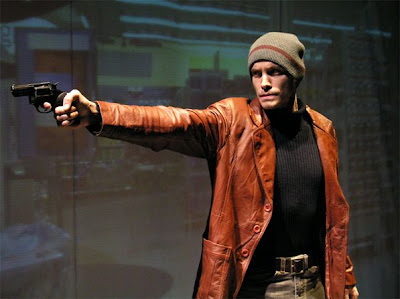

CHEECH, Edmonton 2005, courtesy MichaelCowie.ca

Starting with, “What the hell does multimedia theatre mean anyway???”

It’s one of those lovely bits of language that gets used all the time but nobody really has a handle on its actual definition… just more of a sense of the kind of reaction it’ll produce. Like “physical theatre” or “new media.” Or, “group think.”

Let’s do a quick Google search, shall we? According to Whatis.com, when multimedia is used in live situations it can be “the use of a speaker or actors and ‘props’ together with sound, images, and motion video.” Or, if you check out Scala.com, “The term multimedia describes a number of diverse technologies that allow visual and audio media to be combined in new ways for the purpose of communicating.”

A slide show? A film strip? With (gasp!) sound design??? … yah ok. But nowadays, more likely than not, we’re talking computers. The last few shows I’ve been involved in, a good portion of the production was run off of a Mac laptop. Most young indie producers and designers I’ve recently met own a Mac laptop. Which means more and more shows will continue to incorporate multimedia elements, whether they are designed to fall under the umbrella of “multimedia theatre” or not.

Accessibility is wonderful. But just because my sound design is collection of mp3 tracks played during blackouts, I’m not going to label my show a multimedia production. In fact, few artists would describe a piece as multimedia… even if they’ve included digital projections or other elements... because there is a negative perception that persists.

Why?

Maybe we should look at artists who would rather describe their productions as multimedia than not (… and I’m going to grossly over-generalize here, so please bear with me). I’m going to wager that any theatre artist that labels his/her work as “a multimedia production” has either made a huge error in marketing the piece, or is generally much more concerned with form rather than content. Or, (if I’m more charitable) said artist is more willing to experiment with form… but still at the expense of its substance.

This is a problematic approach. I mean, yes, there is a market for experimentation. But it’s a small one. If you’re okay with that, then go hard. But don’t expect the general public to swarm to your show. An audience’s greatest fear in checking out new works of art is to be made to feel stupid. Experimental theatre usually makes a lot of smart people feel stupid.

I believe in experimentation in theatre. However, I don’t believe in experimentation for the sake of experimentation… unless you’re in school or (maybe) if you’re workshopping a piece. The difference lies in approach. Are you asking, “How can I incorporate multimedia into this work?” You should rather be asking, “What do I need to tell this story?”

A cynic would answer, “You don’t need anything except an audience.” Which I suppose is true, in a kind of fundamentalist point of view. But the key to the question lies within the artist who’s asking, “What do I need?” Because any story will speak to each artist differently, and each artist’s approach to communicating an impression to an audience will be just as unique. S/he is only limited by what tools are available for use.

… Am I then saying that some artists are more predisposed than others to incorporate multimedia elements into their productions? Of course I am. Just as some dancers are more predisposed towards contact improv rather than ballet. And some directors are more predisposed to Shakespeare rather than collective creation. And so on.

As much as my career thus far has generally played out on the sunnier side of experimental theatre, I may be more conservative in my approach than one might guess. While performing in Edmonton, I labeled myself as an actor specializing in physical theatre and collective creation. This didn’t necessarily mean I was always looking for a way to incorporate those elements into my work. It was more of a call to likeminded souls who saw the world in similar ways. It meant that the questions were larger than "How do we incorporate physicality into the work?"; rather, the questions revolved around “What do we want to talk about/ what do we want to create?” Content was key. Form -- experimental/ physical/ collective/ whatever -- was intrinsic.

Now, again, our mistake was less about approach (in my humble opinion) but rather in marketing. (… And, to some extent, execution, but that’s another issue altogether…). We advertised under those labels: ‘collective creation,’ ‘physical theatre’ and even ‘experimental’. And, somehow we were shocked when throngs of people weren’t lining up to buy tickets. Go figure.

Anyway, enough about me: I was talking about incorporating multimedia into theatre, and ended up somewhere along the lines of audience stigma and perception. And marketing. Why on earth does every blog entry always end up about getting bums in seats???

My point is this: multimedia will be used in theatre more frequently because it’s easy to use and increasingly accessible. Does it signify a grand shift in theatrical style? Maybe. Will it lead to larger audiences coming to check out theatre? Probably not – but, as with anything else, it depends on the specific production.

… Is it necessary?

It depends. Start here instead: Who are you?
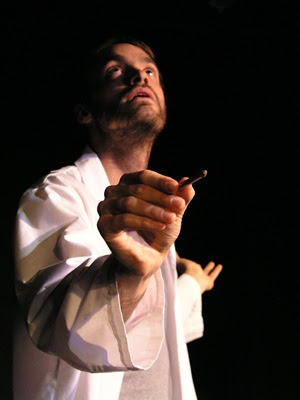
Pause, Edmonton 2004, courtesy MichaelCowie.ca

Wednesday, November 26, 2008

No more Batman?

Is this the end of Batman... or at least, Bruce Wayne as Batman?

Doubtful. We've seen it before. Superman died. Eventually he came back.

It did make for a great story though. It makes for even better publicity: your comic gets mentioned in regular newspapers.

But we're talking iconology here. (Plus a reinvigorated movie franchise.) There are certain heroes that will never die (for long). Their names are Superman, Batman, Spiderman, Hulk, and Wolverine.

Although... I'm still waiting for Captain America to come back. Is he back, yet?

Still, I'm interested to see what happens.

Tuesday, November 25, 2008

War Robots

Yeah, that's right... War Robots

Does this have anything to do with theatre?

Not yet...

There's a play in the making here, my friends. Meanwhile, let's all collectively weep for our future and pray for the coming of John Conner.

Monday, May 21, 2007

Event Movies

On May 25, 1977, Star Wars opened and flipped the film-making industry on its head, 55 days before that, I was born.

There has been a tonne of focus in the media about Star Wars' 30th anniversary because that movie changed... well, everything about movies. The term "Blockbuster" didn't exist before Star Wars, the opening weekend wasn't the litmus test for the film's success, and merchandising was meant to support the movie rather than vice-versa.

There has also been a tonne of lamentation: George Lucas' destruction of the Star Wars franchise through his incessant profit-mongering. The destruction of the film industry itself since the focus has changed from story-telling to special effects and action sequences. There was a quote in the Toronto Star: "The danger is that the public buys into the concept of seeing event movies to the point where people don't want to see anything but event movies."

Well, sure. But isn't that what Hollywood wants too? Why else do they built the huge cinema complexes with digital surround sound and 10 story high definition screens? "Silver-City" was not built for art films from Quebec. Or any other kinds of movies, really. If I'm going to pay $15 bucks for a movie ticket (plus another $30 on a small popcorn), you're damn right I want to see an event.

It IS an event. The experience of seeing an event movie in the (newer) theatres can be awesome (as in awe-inspiring rather than just "cool"). When the story and characters aren't totally ruined by shallow writing... which does happen more often than not with event movies... the experience can be immensely satisfying. And this is not to say that non-event movies don't allow for that same experience. However many people would rather rent those other movies, or catch them on TV a couple years down the road, or download it and watch it on the computer. In my case, I'd rather go to live theatre.

Because what's the point of paying $15 bucks to see a movie that doesn't do the screen it's shown on justice?

I grew up with the Hollywood of today; I can't lament for the past because I don't know what that was. I expect to see trilogies and I expect cool special effects. My expectations are not any lower because I grew up with Star Wars; I get just as disappointed and disgusted when what should be a perfectly good quality franchise gets ruined by "artistic" choices determined by profit rather than creativity.

People usually categorize the event-movie by its mega-budget, its merchandising capability, and its franchising capability. But it's more than that. It's an opportunity for a community to gather. All the "Pirate" nerds, all the "Sci-fi" nerds, all the "Schwarzenegger" nerds, all the "Comics" nerds... they all can get together and identify with one another. "We all belong to this community, we are great in numbers and we are proud of our geek-dom."

I'd like to make event-theatre to be honest. This is a bit of an oxymoron, though, as the experience of seeing theatre is already an event even when you've gone to catch an experimental solo performance with no props. Because the theatre community is by definition a tight-knit local community. And, to be fair, we're mostly made up of former high school drama nerds.

Theatre franchises have yet to be tried... George F. Walker's "Suburban Motel" excepted of course. I'd like to try to create a theatre franchise. If I'm ever successful in doing it, I hope that my artistic choices will always remain artistic.

I hope my audience will hold me to that.